Research Projects
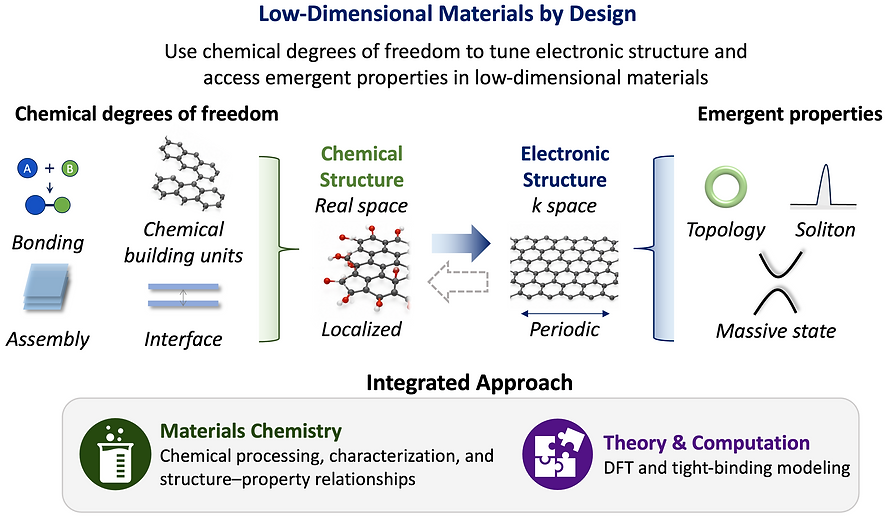
Using zigzag segments as building blocks to design nanoribbons with nontrivial topology.
Discovering localized states with nonzero angular momentum in 2D graphitic networks.
Modeling of electronic structures and properties in collaborative projects.
Uncovering unexpected interlayer reactions between 2D sheets.
Developing organic/inorganic heterostructures.
#Chemical building units #Topology
#Chemical building units #Topology
#Interfaces #Assembly #Bonding
#Interfaces #Assembly
Developing functional materials to address public-health challenges.
Topological Graphene Nanoribbons

We found a class of nanoribbons whose topological phase is determined by the direction of the electric field. Topological 0D soliton states can be generated with energy levels within the finite gaps, at an interface where a change of the sign of the electric field occurs. Our work predicts, for the first time, synthesizable graphene nanoribbons with tunable topological phases.

Massive States in Graphitic Networks
I extended the topological phenomenon from 1D nanoribbons to 2D graphitic networks, by designing four classes of graphitic structures, each of them has different topological features. When the four classes are stitched together, this 2D bulk phase gives rise to 0D topological corner states at the intersection, indicating a topological phase transition in a higher-order regime.

By tuning the smoothness of the domain wall, we further demonstrate the appearance of additional massive localized states carrying non-zero angular momentum, an effect not previously demonstrated in two dimensions. Our results provide a practical framework for realizing experimentally accessible SOTIs and uncover the existence of massive bound states beyond conventional massless ones.
Massive states with angular momentum
Smooth Topological Domain Wall


First-Principles Calculations
I use first-principles calculations to investigate electronic structure and molecular interactions in low-dimensional materials and molecular systems. Current projects include ongoing collaborative studies that are not yet publicly available.
Graphene Oxide (GO) Chemistry
Self-crosslinking of GO sheets
For the first time, I discovered self-crosslinking reactions between GO single layers. This new insight refreshes what people know about a fundamental chemical property of GO. It also reveals a new mode of intrinsic interlayer interaction between GO sheets, which is a foundational structural feature in all GO-based and related graphene materials. It offers guidance on how GO should be processed during manufacturing and applications.

Publication:
Processability of GO doughs
GO has been studied for years yet it is still challenging to standardize its processing and applications. I discovered that the dough state of GO is a good form for manufacturing, especially during storage and transportation. It can be readily dispersed back to single layers in water and offers drastic space and weight saving in comparison to dispersions and avoids safety hazards associated with dry GO solids.


Publication:
MXene Nanostructures

My ongoing research on MXenes combines experimental studies with first-principles calculations to connect chemical and structural design with electronic properties. More results coming soon.
Materials for Public Health
Like much of the world, my research was disrupted by the COVID-19 pandemic. Faced with the profound uncertainty and human cost of the crisis, I felt compelled to ask how I, as a materials scientist, could contribute. Rather than simply reframing my existing research around the pandemic, I joined my advisor, Prof. Jiaxing Huang, in starting from the needs of the crisis itself. We studied the virology and public-health literature, revisited textbooks outside our usual fields, and spoke with healthcare professionals to identify problems where materials science could make a meaningful contribution. This process led me into entirely new research questions and ultimately launched a new direction in my work on materials for public health.
COVID-19: A call for physical scientists and engineers
Together with nine brilliant frontline public health workers, clinicians, biomedical researchers in China, and my advisor, I wrote the first article that serves to share basics about viruses and infectious diseases, define research needs and problems, share hypotheses and new ideas, and call for action in the field of physical science. Later we were fortunate enough to receive funding to actually pursue two of the concepts brought up in the perspective paper.

Making droplets less infectious
We developed a chemical modulation layer that can change the composition of outgoing respiratory droplets released by the wearer. A model system with polyaniline and copper salts/phosphoric acids is demonstrated. The results show even loosely packed fabrics can modify a significant volume of escaped droplets. Reducing the infectiousness of the sources can cut down direct person-to-person transmission, reduce indirect transmission through fomites, and lower the burden of other measures along the transmission pathways of infectious respiratory diseases.

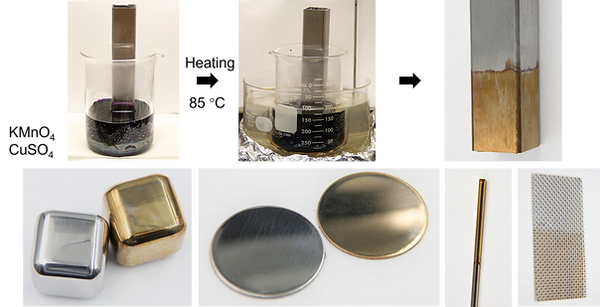
Self-sanitizing surface
We found a facile one-step solution processing method to retrofit stainless steels with a conformal, continuous, and ultrathin coating. It is shown that copper ions can be released from the coating and induce an antimicrobial effect, which could contribute to reducing fomite infections and slow down the transmission of infectious diseases. The coating is rub-resistant due to the lack of a sharp interface, making it suitable for sanitization purposes for touch surfaces.
Publication: